Wednesday, January 01, 2025
Self-doubt
One might think that as one ages, self-doubt vanishes. How I wish that could be true!
The year of 2024 has seen me officially operating in the leadership category for one full year now. The journey has been one of self-discovery - including becoming aware of self-doubts and strategies to overcome it.
There was a brief and intense period of self-doubt during this year, particularly with respect to my leadership position. I have been fortunate to have mentors to help me out. The key help was to give assurance and point out three kinds of categories of people – those whose self-assessment and their
worthinessness match, those who estimate themselves more than their worthiness and those who estimate themselves less than their worthiness. . But what was interesting and useful was when my mentor pointed this to me and said that I fall into the last category and the anxiety that I might slip into the second category was enough to cripple. That, I think is the most insightful thing that I am keeping in my mind – helping me to sail through.

Cannot Not Do
I was aware of the idea that some people say that there are things that they cannot not do. It was not until this December 2024 that I realized that there are things that I cannot not do - it is so inherent that I seldom realized it. And this realization came in a discussion with a friend - both of us sitting in a Buddhist cave in Lonavla! Should I say, this is a Buddha-kind of revelation! :-D
Tuesday, December 31, 2024
The Teaching Learning Symposium at SASTRA
Unlike many other initiatives that have happened, I wouldn't, for once, deny my small but significant role, in creating this teaching learning atmosphere here. :-)
Friday, December 27, 2024
The Friendship Process
Below is something that I wrote/curated/summarized way back in 2009 and shared it with a few like-minded friends. Just sharing it in the open just to ensure it is digitally saved for eternity! :-)
The Friendship Process
Friendship is a unique relation in everyone’s life. We keep developing friends all through out our life and cherish its memories for life time. As our social circles grow larger and larger, our dynamics and interaction with peers and colleagues change our perception of friendship and of life itself. The observation of this ‘evolution’ of perception within myself and with a few other friends motivated me to read on the ‘Friendship Process’ when I bumped into the book by Beverly Fehr on ‘Friendship process’. The book has rightly called Friendship a process, for, it is a step-wise growing relation, solidifying with time. This particular book interested me in its review which gave appreciation to how it has examined the process of friendship, the meaning it gives to our lives by documenting several research studies in a systematic way. Here, I summarize whatever message I grasped from this book.
Functions of Friendship
We all have been benefitted a lot from our friendship, but when asked what we benefitted, I am sure most of us would not be able to answer it. Nevertheless, an objective mind (Solano 1986) has set out to define the functions of friendship as follows:
- Friends meet our material needs. They provide various kinds of help and support.
- Friends meet our cognitive needs. They provide stimulation in the form of shared experiences, activities, and the lively exchange of gossip and ideas. They also provide a frame of reference through which we can interpret the world and find meaning in our experiences.
- Finally, friends meet our social-emotional needs through the provision of love and esteem.
While it may look like just three short sentences to describe the functions of friendship, they are very profound and I am sure it can be related to a number of subjective experiences.
The Evolution of the Concept of Friendship as the Child Grows
Our perceptions change with time and so does our concept of friendship! There cannot be an ideal definition for friendship for people of all ages. For example, in preschool, we would identify someone as a friend if
1. He/She plays with us.
2. Shares toys with us (prosocial behavior)
3. Doesn’t hit us (absence of aggression)
When asked why a particular individual is a friend, we often relate to the person’s physical characteristics (e.g., she has wavy hair) or possessions (e.g., he has a nice bike).
As we grow, (6- 7- year old), we start to less emphasize on physical characteristics or material property and emphasize more on relational features such as affection and support (helping, sharing). A more abstract concept of friendship develops as we grow even older which can be categorized into five features: support (e.g., sharing/helping), association (e.g., propinquity), intimacy, similarity (e.g., common activities), and affection. It is easy to note that there is a transition of the concept of friendship from concrete, observable characteristics to an abstract, qualitative conception of friendship.
Adolescents:
In adolescence, the concept of friendship expands to include two relational features that also become central: Loyalty (reflected in a friend’s willingness to ‘stick up for us’ and not ‘talk behind our back’) and intimacy, defined as sharing one’s innermost thoughts and feelings. Once these features emerge, the concept solidifies with few age-related changes thereafter!
Adults:
In adult friendship, trust, interpreted as keeping confidences and engaging in intimate self-disclosure, stands as the first defining quality of a friend. In addition, it has been observed that men nominate socializing features such as enjoying the friend’s company and going out with the friend.
While it is not necessary that the above ARE the ways of evolution of the concept of friendship within us, I believe it is generally applicable.
Conceptions of Ideal Friend
Researchers have also set out study on the conceptions of ‘ideal friend’. A research conducted in India by Basu and Mukhopadhyay (1986) on conceptions of ideal male and female friend held by young adults revealed the following:
An ideal male friend:
- Would possess the qualities of understanding, honesty, loyalty, cooperation, reliability. (Characteristics such as noninterfering, prudent and having similar interests were seen as less important.)
An ideal female friend:
Conceptions of men: An ideal female friend possessed virtually the same qualities that were valued highly in a male friend.
Conceptions of women: An ideal female friend possessed characteristics such as good-tempered, sacrificing, witty, and loyal.
Actual and Ideal friendship
Though such concepts of ideal friendship exist, it has been found that in reality there is only a thin border between actual and ideal friendships. Both state the categories Reciprocity (reciprocating to a friend), similarity (in terms of shared experiences), compatibility and structural dimensions (proximity, duration of friendship) to define friendship. The only difference was that actual friendship ranked similarity first followed by reciprocity whereas ideal friendship ranked reciprocity followed by similarity. In my view, reciprocity is a very important factor in the development of friendship. But one must also understand that reciprocity comes only if there is a similarity and a myriad of factors fall into place for the friendship process to happen. This necessitates us to understand the factors that are key to the development of friendship.
The Development of Friendship
A necessary first step for the development of most friendships is that two people’s path must cross. This is more likely to occur if the two people live near one another (e.g., same neighborbood, same building, same floor, same room) than if they do not or share a common workplace. Once two people meet, whether or not they decide to pursue a friendship depends on several additional factors. At the individual level, each scrutinizes the other for evidence of disliked qualities or other characteristics that may make him or her unsuitable as a friend. If these exclusion tests are passed, then inclusion tests will follow. It is likely that a friendship will be sought if each perceives the other as attractive, socially skilled, responsive, not shy, and if the two people are similar in a variety of ways. If both exclusion and inclusion tests are passed, one might think that a friendship would be inevitable. However, situational factors influence whether or not a friendship is actually formed. Research on these factors suggest that two people are more likely to develop a friendship or they anticipate ongoing interactions, if they are dependent on one another, if they see one another frequently, and if each person’s ‘friendship dance card’ still has some room on it. Finally, the likelihood of friendship formation depends on dyadic variables such as whether the two people like one another and whether there is an appropriate sequencing of the depth and breadth of self-disclosure. Given the myriad factors that must coalesce, it seems remarkable that people are able to form friendships at all! Nevertheless, there are friendships when we cannot relate how it actually happened, or cannot relate that friendship to many of the above factors! Typical examples include school friends whom we have known for years.
In its growth, conflicts are very common in friendships. Especially when each friend has different profession, completely unknown to the other (incase of school/college friends) and when the friends are from different societies or brought-up. Friends have to strike a delicate balance between each person’s constantly changing needs for independence and dependence, intimacy and distance and so on. These dialectics may contribute, in part, to the relatively frequent experience of anger and conflict in friendship relationships. But all the more, a concrete relation builds when one understands
In my view, there is no better a place to understand and observe most of the above stated facts than a hostel!
Thursday, December 26, 2024
Looking back to look forward – 2024
We live in a society. What this means is that we have to “deal” with humans. With some – only a few hours, with some – for a few months, with some – a few years, but with some – a lifetime. Whatever the time frame of the relation in ‘dealing’, there are certain key aspects to it – depending on the purpose. However, one that seems to be common across, irrespective of purpose, is understanding expectations. Sometimes with some people, these expectations are implicit and some other times with some other people, these expectations are explicit. The key is to know when and for whom you want to spend time to understand implicit expectations. The second key aspect is to what extend you want to satisfy the expectations – again, for whom and when. People call these by several terms – prioritizing, choice, sacrificing, trading off, optimizing – but whatever term you choose, it boils down to satisfying expectations in the relations – to what extent and for whom.
Sometimes, the question of ‘for whom’ and ‘to what extent’ is answered by oneself. Many a times, we are right, but there are times when you cannot decide. It is those times that require a support group – a peer group, a friend, a mentor etc. The importance of such a support group was something that I realized very much in 2024. I must say I have been fortunate to have such a support group – and I am grateful to all of them.
It has also been a year of learning in terms of oppression – particularly against women in our society. They are victims of centuries of oppression and it takes enormous effort to break out of the conundrum – for men – to realize the oppression, and for women – to make men realize it.
Professionally, there have been circumstances where I just had to stand witnessing helplessly when women are social victims to oppression – the heart wrenching is even more as this happens in the educational realm.
2024 has also been a year of learning about myself – self-discovery of sorts – in the context of my current leadership position. I have been natural at creating platforms or “communities” for integrating people/intellect – beginning with ‘Science Arattai’, the teaching-learning newsletter, the bioinformatics center. I have always believed that coming together is a great thing – but seldom did I realize that creating the platform to come together is an essential quality at a leadership level. Thinking further, it is not something that I have done after starting my profession, but right from student days. Be it the departmental yahoo groups created at my UG college, or, the yahoo groups for my own UG classmates, and later, as a graduate student – in setting up the Journal Club at ChBE, NUS. With the advent of WhatsApp and google groups – many of these communities are now virtual in nature. Very quirkily, these kinds of initiatives have never been in the personal front – something that I must think about.
This also gives me an insight that life is not all about utilitarian-driven purposes – it is about relations. Some relations – you are born into, some created. Whatever it is, life is beautiful when you maintain relations and the journey is all about learning to maintain it.
It is also worthwhile to remember the quote from the drama series Emily in Paris – “You live to work; we work to live”. I think this brings in a whole lot of clarity to those (me!) who have been told that work is God. Work is indeed God – but not to the extent that one loses to build relations and appreciate beauty in life.
As I officially and clearly graduate to the second half of my lifetime (assuming that the maximum life time is 80!) – I can now see myself less of pushing myself to be at the forefront, more of seeing my students grow and mature – professionally and personally, less of seeking external acknowledgement, more of preferring retreating to a quiet space and spending time with loved ones. Perhaps, this is why they say “Life starts at 40”!
Having officially graduated to the second half of my lifespan, if there is one “insight” or “advice” to give – it will be to take efforts to sustain your relations (with clauses on when and whom, of course!) and do not underestimate the importance of friendships all through your life – they mature over time. A trustworthy and non-judgemental friendship blosoms over time – and this includes with your life partner! Let’s celebrate life!!
Sunday, June 26, 2022
Why not - Engineering or Science?
A senior colleague of mine brought my attention to an advertisement with the tagline "Why not?" by a company called Atomberg. Indeed a wonderful advertisement! But the discussion point was that Engineers and Innovators ask the question "Why not?" whereas scientists ask "why?". It is not true that Scientists do not ask "why not". In fact, only because scientists ask "Why not have the eyes in the back of the head? Why not have an ellipsoid soap bubble?", they have found answers to why the eyes are in the front of the head and soap bubbles are spherical in shape. The question "why not" plays an important role in science and engineering - and our pursuits in knowledge, in general. The only difference I see between science and engineering pursuits is that focus - Science's main preoccupation is that of understanding the world that exists around us, whereas, Engineering's preoccupation is that of making useful products for the human kind. I am hoping that I will be able to tease out more on the similarities between science and engineering in the upcoming posts.
When are we going to change the way students learn?
I distinctly remember that no one taught me to use Word/Microsoft/.... or any other documentation tool. But today, these are there in the school curriculum. That is a good thing, right? At the outset, yes - but let me also show another dimension to it, which I think is far too harmful.
It is good because, the world has moved Digital - our children need to be able to cope up with the these aspects, which is kind of very basic skills these days. I agree to this. However, does that mean we have to ask in the question paper something of this sorts: "We use _____ to insert pictures in word document (fill in the blanks)"?? You might have used word in your career - can you guess what should come in the blank space? I wouldn't be surprised if you cannot recall that - I couldn't too, and I had to open my word document to check what it is! We have learnt to use word - which is the most important thing. Remembering that there are tabs called "illustration", "smart art" etc., and "vomitting" it in the question paper serves no help - you agree with me, right? But what does the curriculum do these days? They have successfully brought these into "books" and students have to read through the books to know how to crack the exam. Is this of any value? No, because it does not help them to use word. It is just familiarity of words which has no value. Well, I would still be okay if this does no harm to the kids. Unfortunately, such bookish knowledge of practical skills only bore the children, so much so that, they hate schooling and eventually learning at all. Is that harmful - YES! When are we going to understand how children learn and create a space for them to learn joyfully? It is only when there is a passion in doing things (here, learning), excellence begins. We aspire for a country of self-reliance - which may remain words in white papers unless the curriculum changes!!
Monday, May 30, 2022
2021 - Looking back
It has been long due to complete the looking back blog that I usually write. Had been waiting for something to happen - but that is getting prolonged, hence decided I must finish this. :-)
The January started normally, with care and trepidation as the world was seemingly trying to get out of the covid. The campus started functioning with half the strength. By February, arrangements were made for students to come to campus. March looked nice with students in campus - regaining the lost charm - yet the fear of covid breakouts did not die down. As the number of covid cases started to rise again, the educational institutes had to go into a lockdown mode (not just educational institutes, but the whole of Tamilnadu) again by the third week of April 2021. After a turn of events in Thanjavur, we got locked up in Dindigul during the entire lock down period - until June. May was the most difficult phase - about 4 loses of near and dear ones - including a cousin, house owner couple and a close friend’s father. Devastating it was - and the entire month had such horror stories from all corners. The entire human race went through a tough phase in this second wave which occurred between April - June 2021. Amidst all these, we didn’t give up conducting exams - with the justification that only then students’ future will be secured. So, exams went on up to August 2021. After a very brief breathing time, senior semester classes and PG classes started in October and the next semester went in full swing in November to complete the syllabus. By December, all senior year students were in campus and refresher classes conducted. The semester came to an end in Jan 2022 with exams in Feb 2022 and the subsequent semester started in March 2022. It has been a race that we have been running to catch up with the old schedule of starting the odd semester in July…looks like it will take one more year to reach that.
On the research front, DBT is still asking for one document or the other (and as on date of writing, we haven’t received sanction yet). No communication from BIRAC as well. My research is also taking a focus on AMR with a publication with a colleague and conference presentations in Inbix and Insyb2021 - all in AMR.
The teaching-learning newsletter continues.
In the family front - Family becomes bigger by one with the Birth of Vitharsan to Subee in March 2021. Viyan joins Yagappa school from June. November-December - sees ancestral blessings and plans to root the family gets more concrete. Gowri starts freelancing on educational content creation.
Personal front - A teaming up with Ruban led to a series of discussions on design thinking. It was launched in the YouTube.
On the ThinQ front - there was a rejig of the guiding principles . It was decided to remain a low-budget financial entity with no full timers supported by ThinQ.
Saturday, January 08, 2022
Entrance exams
About 20 years ago, when the TN government abolished entrance exams for professional courses (engineering in particular), i thought that was a stupid move. I thought entrance exams serve to establish quality. The age was young. In retrospect, i think my reaction 20 years ago was because it was during the preparation for the entrance exam that i understood many nuances in the concepts and learnt to apply them as well. I had the 'fortune' of attending a coaching class, which i think did a good job because i eventually got into a college of high repute - whether this is a correlation or a causation remains unknown though. These resulted in the notion that scrapping entrance exam was a bad idea. However, 20 years later, having seen at least some parts of the society - locally and globally - i cannot, but be amused by my ignorance at that young age. Let me elaborate.
The central idea of entrance exams, as i see it, was to filter students to be admitted in the programme. That is, the number of seats available was far lower than the number of students competing for the seats. So, we needed a metric, for only practical purposes, to filter off candidates. Entrance exam score was the metric. However, now i realise how flawed this idea is because of the underlying notions in it:
(1) the current board exams are incapable of helping to select candidates for professional education, (2) the entrance exam is the perfect exam that can guarantee good professionals, (3) if we get "sub-par" students, we, as educators are not interested in investing our time to help them achieve their aspirations.
The other aspect that i was sensitive to, but not a large extent was the accessibility of the coaching centers, which,in my case, played an important role. There are umpteen number of people who cannot afford a coaching centre for entrance exam. It has almost turned out to be the case that the probability of getting through the entrance exam with good score improves significantly with attending coaching centers. Is this right? Are we saying, as a society, we will encourage and support only those who are able to attend coaching centers? Are coaching centers imparting anything of educational value other than such exam preparation? Are we to stand and encourage such mechanisms in a society?
20 years ago, i didn't have the maturity to think about these aspects. But i do now. Entrance exams are waste of time and resources. This should be invested in the foundational education system such that we groom tomorrow's citizens.
Tuesday, May 04, 2021
Genomic Surveillance - SARS-CoV-2 Virus
The advent of technology has enabled the possibility of using genome sequences to understand and combat the SARS-CoV-2 pandemic that started in 2019. Genome sequencing is particularly helpful in outbreak analysis and intervention, identifying variants and their pathological basis of spreading and infection, and a host of other possible understanding and paving way for interventions. It has been more than a year since the pandemic affected several countries now. They have been coping up and investing in infrastructure development and attending to immediate needs to help people. But simultaneously, countries have also set up genomic surveillance because that, along with epidemiological surveillance is important for treatment strategies and to curb the spread. India too has set up its genomic surveillance consortium, INSACOG (http://dbtindia.gov.in/insacog) - in the late 2020s, which is helping scientists study the spread and infection of the disease. However, as of now, the number of genome sequences in GISAID (https://www.gisaid.org) doesn't seem to commensurate with the number of reported cases, particularly in India, and more specifically in Tamilnadu. See the figures below (data collected from GISAID as of 9 am on 03 May 2021).

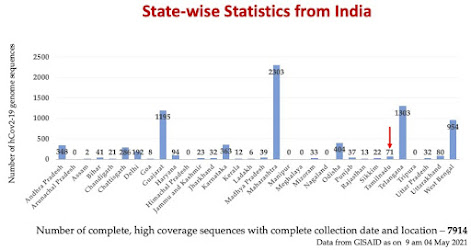
With the establishment of INSACOG and a good sampling strategy, I think the situation would improve in the coming days. I also hope that the government/research agencies will include more sequencing partners, improve clinic-academia partnership etc to improve genomic surveillance.
Going forward, I think India should set up a robust genomic surveillance network to tackle any future endemic/epidemic/pandemic. A lot of thoughts and funds need to put into this in addition to investing in building up the overall public health infrastructure.
Friday, January 01, 2021
Learnings 2020
I think the important learnings over the last year for me was:
1. One needs opportunity to showcase talent.
2. People in positions of responsibility should create the opportunity for others intentionally.
3. People in positions of responsibility should also create a "community" of interest groups. It is in being together we flourish!
Thursday, December 31, 2020
Year 2020
Year 2020
The year 2020 got famous atleast a decade ago when Dr. Kalam, the former President of India articulated his vision for India to be achieved in 2020.
The year indeed began with its own charm, as with any new year - lots of plans, dreams and hopes. The visit of Dr. Laksh from NUS as part of a research collaboration with a colleague at SEEE had spurred interest in newer perspectives of enhancing Teaching-Learning, The taking up of responsibility for coordinating IIE-B-2020, Getting through with the DBT center for Bioinformatics proposal - these were some of the plans intertwined with dreams and hopes with which 2020 began.
January primarily went in preparing for the DBT center presentation - submitting documents coordinating to find collaborators for the National Network Project etc. A hereculean task indeed. The presentation happened in February - I along with Dr. Thamotharan and Dr. Ganesh made the presentation at Delhi before a panel of experts. The immediate comment we got from the panel was that : this is one of the best presentations! During lunch, one of the panel members encouraged us to further collaborate with people world over so that more meaningful work can be done. Later, the news that trickled was that out of over 600 proposals from the entire country, 40 were shortlisted and called for presentation - and all of them.would be funded! (Though, we are yet expecting the sanction order!)
Comes March, with Covid19 marching into every country. India enforced lockdown from March 23, and hence the campus was closed. 2020 turned out to be a terrible year for the world (and for the family - with the loss of my cousin succumbing to Covid 19). Under the direction of our Director, however, a team of us worked on checking the potential of molecules in traditional formulations for their effectiveness against Covid19. Some molecules indeed show potential - yet to get funds for verifying it experimentally (proposals have gotten rejected).
With the university closed down, we geared up for online exams for students - the whole of April went in it - questions and evaluation etc. DBT continued to ask further documents revision of budget all through April and May and these went on parallel tracks.
The Teaching-Learning newsletter saw its first issue in May - with a few like-minded people writing for it and forwarded by Deans in the school. The hope is that this newsletter will be a platform for sharing good practices, learning from peers of their insights and move towards scholarship in teaching-learning.
May also saw the coordination of another proposal in collaboration with Thanjavur Medical College - submitted to BIRAC - the presentation of which happened in June - and we are eagerly awaiting for the decision as well.
In parallel, June and July went in getting students to enrol for the new MSc Bioinformatics program, preparing submitting for necessary approvals from academic council etc, and as well in gearing up for the upcoming online semester.
The online semester began in August for the senior years and in October for the first years.
Reconnecting with an old mentor also saw some productive work in terms of manuscripts - exploring newer vistas in machine learning.
ThinQ activities:
The year began with our first workshop in Coimbatore in the Edu-Intech conference - the first of its kind - where Mo unveiled Education 5.0. This was followed by a workshop for the participants - where i was a facilitator. Later, in April, FACE academy approached ThinQ for a webinar for Engineering teachers. I co-facilitated it along with Mo and Deesh. Was attended by about 2000 engineering teachers all over the country.
IIE-A started in May and continued until October. Hectic times indeed. Starting September, i took up.an active role as the coordinator for IIE-B - starting from participant selection, inviting them, nudging facilitator preparation in thr midst of getting my own session prepping. IIE-B was conducted completely online this time - over 4 weekends in December. So, December was fully packed!
In December, our proposal (with a colleague/friend) for a startup was recommended. Awaiting further details on pursuing it.
On the family side - all is well. Viyan turned 6. He has developed an interest for reading of English story books (Enid Blyton's Magic Faraway tree helped a lot) and has slightly outgrown his obsession for dinosaurs toys. But his obsession with Dragons remain. He has got interested in video games (Hungry Shark, Hungry Dragon, Jurassic Fight etc). Trying to get him hooked into reading Tamil books and drawing.
Looking back, the year has been productive one - with lots of learning, and laying the steps for a lot of plans! Hoping for more productivity and learning in the upcoming year! Look forward you 2021!!!
Thursday, November 14, 2019
Scientific Theory Construction through Language Structure
The 9-day workshop (Nov 11 - 21, 2019) on theory construction using language structure is proving to be helpful in the further understanding of some of the concepts, particularly theoretical categories.
At the outset, the study of language is conceptualized as an instrument of access to the study of the mind. The regularities in, within and across languages, points to 'mental systems' that are universal to humans (i.e., the mind generates these regularities). More specifically, the theoretical categories (such as noun, verb etc.,) identified from these regularities are seen as properties of the mind. Analogous to this, defining the theoretical categories such as "mammals" etc can be seen as an access to understand the biological world, more specifically it's diversity. After defining these categories and arranging it as a classificatory tree, it becomes all the more interesting to ask why such a classificatory tree occurs.Monday, December 24, 2018
Looking Ahead by Looking Back - 2019 - 2018
It is that time of the year to recollect what happened in the last one year, as a way of preparing, planning for what lies ahead. Apart from the usual academic classes that I handle, there have been a few more eventful things.
The 'eventful' things of the year that I could recollect starts with the Chennai ThinQ Retreat in March. It was indeed an eye opener into Philosophy and the overall alignments of ThinQ (www.schoolofthinq.com) towards education. While the mainstream education focuses on the Ontology, ThinQ proposes to focus on epistemology and base the curriculum based on a detailed study of comparative epistemology across disciplines.
Later in March, I was selected as the mentor of change by the Atal Innovation Mission. The AIM aims at getting school students to find innovative solutions to the local problems that they find. While this is a wonderful initiative by the GoI, I am afraid it needs a little more backing up for both the school and the mentors. More of it later.
After a memorable family vacation in May, the academic year started with a good note - the sanction of a grant from the GoI. The grant proposed to investigate the effects of osmolytes on protein-DNA interaction with an aim to delineate general principles and ability to tune the specificity of protein-DNA interactions.
The IIE-2018 course of ThinQ started in May and extended until late October, which was again a great learning experience. Had the opportunity to attend two of its One-Day-Meetings, which, as usual was illuminating. Later, the November retreat sensitized to the typology of arguments and the separation of the "why" and "how" questions. But the main take-away of the retreat was the sensitization to trans-disciplinarity and the ability to identify "ideas" (at least, I got what I meant as "idea" only now!).
November also saw the "Gaja" cyclonic storm in Thanjavur and nearby districts which was extremely devastating. We, at home, had no power for three days - a unique experience. Luckily we had a relative at the heart of the city where there was power. The important learning: One can live without power, but not without water!
Comes December then with my son's 4-th birthday. This year, I didn't get myself too much involved in the conduct of the INSPIRE camp at SASTRA. Handed down the torch two years ago and sort-of hand holded it until last year. But this year, the coordinator of the last year hand-holded for this year's coordinator. So, I am happy that what I initiated has been successfully passed on and trained to be passed on for the fourth consecutive year. With this, the year comes to an end on a good note.
The year ahead is starting with the IIE-2018/19 F2F workshop in Pune - eagerly waiting to experience - a new set of participants, a new set of lesson plans! A few more pending commitments, satisifying grant requirements/objectives are things that carry over from 2018. As for new initiatives for the year ahead, looking forward to establishing the Teaching-Learning club at SASTRA such that the Department of Education can take over. Need to plan something so that ThinQ's educational goals can be taken forward. With this, let me stop by saying that I am looking forward to 2019!! :-)
Thursday, June 07, 2018
Language & Children
Would like to catalogue an interesting thing that we noticed in our Son yesterday:
He was playing with ice cubes and he said "Jillu potruchu". First I couldn't understand it and then my wife pointed it out that he is using it similar to "Soodu potruchu".
மொழிமுதல் எழுத்துக்கள்
Suppose you are asked to go through the entire lot of Tamil books and identify which letters (of Tamil) can form the first letter of the word, which letters canNOT form the first letter of a word, what would you find? Try it!
The early tamil grammarians probably undertook this exercise to find rules that have been followed in our language use. This has been compiled in Tholkapiyam - Nannool books.
For the above specific question, here is the answer: http://www.tamilvu.org/slet/l0100/l0100son.jsp?subid=11
The content of the same is being pasted here in case the above link goes defunct:
1. பன்னீர்-உயிரும் மொழி முதல் ஆகும்.
2. உயிர்மெய் அல்லன மொழி முதல் ஆகா.
3. க, த, ந, ப, ம, எனும் ஆவைந்து எழுத்தும்
எல்லா உயிரொடும் செல்லுமார் முதலே.
4. சகரக் கிளவியும் அவற்று ஓரற்றே-
அ, ஐ, ஒள, எனும் மூன்று அலங்கடையே.
5. உ, ஊ, ஒ, ஓ, என்னும் நான்கு உயிர்
`வ' என் எழுத்தொடு வருதல் இல்லை.
6. ஆ, எ, ஒ, எனும் மூஉயிர் ஞகாரத்து உரிய
7. ஆவொடு அல்லது யகரம் முதலாது
8. முதலா ஏன தம் பெயர் முதலும்.
9. குற்றியலுகரம் முறைப்பெயர் மருங்கின்
ஒற்றிய நகரமிசை நகரமொடு முதலும்.
10. முற்றியலுகரமொடு பொருள் வேறுபடாஅது-
அப் பெயர் மருங்கின் நிலையியலான.
For a detailed explanation of the above rules, see https://ta.wikipedia.org/s/rra
Briefly,
12 உயிரெழுத்துக்களும் மொழிக்கு முதலில் வரும்
க வரிசை 12 எழுத்தும் மொழிக்கு முதலில் வரும்
த வரிசை 12 எழுத்தும் மொழிக்கு முதலில் வரும்
ந வரிசை 12 எழுத்தும் மொழிக்கு முதலில் வரும்
ப வரிசை 12 எழுத்தும் மொழிக்கு முதலில் வரும்
ம வரிசை 12 எழுத்தும் மொழிக்கு முதலில் வரும்
ச வரிசையில் 9 எழுத்து மொழிக்கு முதலில் வரும். (ச, சை, சௌ வராது)
வ வரிசையில் 8 எழுத்து மொழிக்கு முதலில் வரும். (வு, வூ, வொ, வோ வராது)
ஞ வரிசையில் 3 எழுத்து மொழிக்கு முதலில் வரும். (ஞா, ஞெ, ஞொ)
ய வரிசையில் 1 எழுத்து மொழிக்கு முதலில் வரும். (யா)
The word 'சரி' wasn't in existence in those days. The equivalent word was 'ஏற்பு'. Hence the rule that says ச cannot be the first letter of a word is obsolete today. However, certain rules are not made obsolete today - perhaps because of people who are sticklers to rules. For instance, ராமன் is written as இராமன் today because ரா cannot be the first letter as per the rules. I don't understand why certain rules can become obsolete and certain others cannot!
Now, suppose we give the above tasks to kids and ask them to formulate the rules, then we will help them to
1. Explore the language
2. Generalize and make abstractions
If we value the above to outcomes, then we need to rethink linguistic education.
Grammar
Well, for anyone who has been through school, grammar is a set of rules that have been pushed down into our throats. This makes everyone of us dread about grammar classes. However, grammar is not just the set of rules. It is about discovering oneself - the framework of language within us. Take a look at this link to understand what I mean: https://allthingslinguistic.com/post/48308402369/teaching-linguistics-to-elementary-school-students I am also posting the contents of the link here - in case the link goes defunct.
Several interesting posts from Literal Minded by Neal Whitman on teaching elementary school students linguistics. Excerpt:
“Before we start,” I said, “I need to make sure I know what language you guys speak.”
“English!” they said.
“Ah, good! That’s what I speak, too. So Mrs. K,” I said, turning to Adam’s teacher, “Do they speak English pretty well?” She said they did. “OK,” I said. “Let me try a little test. See Mrs. K. here? Could I say, ‘Mat the on Mrs. K. sitting is’?”
I called on one of Adam’s classmates. “Jenny, is that good English? ‘Mat the on Mrs. K. sitting is’?”
“No,” Jenny said.
“It’s not? Then how would you say it?”
“Mrs. K. is sitting on the mat.”
“Really? How about the rest of you? Who would say ‘Mrs. K. is sitting on the mat’?” Most of the hands went up. (Well, more accurately, most of half of the hands went up.) “And would anyone say, ‘Mat the on Mrs. K. sitting is’?” None of them would.
“What? Why not? It’s the same words!”
“It’s the wrong order!” one or two of them said.
“Who told you that? James, did Mrs. K. tell you that it’s ‘on the mat’, not ‘mat the on’? No? Carly, did your mom tell you it’s ‘is sitting’ and not ‘sitting is?’ She didn’t? Then how did you know?”
“It just sounds right,” she said.
That's how grammar starts!
Some order of words sounds right and some others don't. We derive rules based on what sounds right (for the native speaker). Consider the case where we teach children how to derive the rules and a case where we push a set of rules down their throat. Which one do you think has more value to teaching to kids? I am sure you would say the former. When we teach kids to derive the rules by themselves, they not only automatically learn grammar, but also learn the norms of scientific inquiry.
There is an excellent article by Prof. Samuel Jay Keyser on "The role of linguistics in elementary school curriculum" (I cannot find a link; you can leave your email id in the comments section if you want a pdf copy of the article) that articulates how linguistics can be used to teach kids scientific inquiry.
Wednesday, May 16, 2018
Ullurai Uvamum
In Tamil literature, this is a way of alluding to something else than that which is specified in the poem. That is the meaning goes beyond the literary meaning (hidden meaning). A good example is what I found in the book "Smile of Murugan": (page 109).
" Look there my lord,
Near that lovely pond
With its broad green lotus leaves,
The heron
Motionless and without fear
Stands shining
Like a white and golden
Conch".
Heron is a white bird (naarai). Conch is sangu.
The above is a poem, a lady love tells her hero.
The first layer of meaning is the above.
The second layer of meaning comes from the fact that the bird stands motionless and without fear. When a heron stands motionless and without fear, it means no one is around. That is, the place is deserted.
The next layer of meaning that the author states in the book is that, the lady love indicates that the place is deserted, and hence is ideally suited for making love.
Thus, in the poem, the lady love, very elegantly and indirectly conveys her emotions to her lover. This is ullurai uvamum. The other stunning part is the acute observation that the heron stands motionless and without fear only when there is no one around. How much they have observed nature!!
Tuesday, May 15, 2018
Features of Akam Poetry
There seem to have been some rules/committment that has been followed in the Akam poetries:
They are:
1. Men and women in the poems should not be mentioned by real or imaginary names. They can be referred to by as "turaivan", "natan", "ulavan" etc. - the general names or as pronouns "avan, aval".
2. Not to deal with the dead and the supernatural. As Kamil puts it, they are the unliving and uncreative. "...great poetry should be that which generates life, relives and recreates the splendour and music of life, at the living moment."
These commitments render these poems a cosmic effect, that which is perennially alive.
Another unique feature of these poems is the metaphors used. Almost all of the metaphors are related to the immediate natural surrounding of the hero/heroine. For instance, in Kuruntokai 399, the poet says:
ஊருண் கேணி யுண்டுறைக் தொக்க
பாசி யற்றே பசலை காதலர்
தொடுவுழித் தொடுவுழி நீங்கி
விடுவுழி விடுவுழிப் பரத்த லானே.
Translation from the source:
My pallor is like the green algae
growing on the pond
where the village gets its drinking water;
every time my lover touches me
it disappears;
every time my lover leaves me
it spreads back again.
Here, the poet compares the changes in the pallor of the "talaivi" to the movement of the algae in the pond when one touches it. Thus, it implies that people were acutely observant of the natural surroundings and lived a life of harmony with nature. Perhaps this is a message in itself to the people - live in harmony with nature!
(source: Literary Conventions in Akam Poetry by Kamil V Zvelebil).
Monday, May 14, 2018
Ainkurunuru 409
Below is a poem from Ainkurunuru (poem number 409) that I think is extremely nice and portrays the love in a family in a very creative way.
புதல்வன் கவைஇயினன் தந்தை, மென் மொழிப்
இனிது மன்ற அவர் கிடக்கை,
நனி இரும் பரப்பின் இவ் உலகுடன் உறுமே.
Translation by AK Ramanujan:
The father holds his son close,
the son's mother holds them both in her arms.
Such a state is beautiful. In its little space,
it is large enough to hold the wide world and all the lives in it.
[I read this from: "Literary Conventions in Akam Poetry" by Kamil Zvelebil.
Subscribe to:
Posts (Atom)