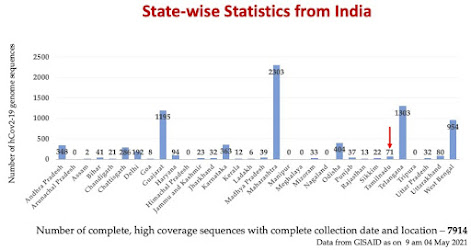
Tuesday, May 04, 2021
Genomic Surveillance - SARS-CoV-2 Virus
Friday, January 01, 2021
Learnings 2020
I think the important learnings over the last year for me was:
1. One needs opportunity to showcase talent.
2. People in positions of responsibility should create the opportunity for others intentionally.
3. People in positions of responsibility should also create a "community" of interest groups. It is in being together we flourish!
Thursday, December 31, 2020
Year 2020
Year 2020
The year 2020 got famous atleast a decade ago when Dr. Kalam, the former President of India articulated his vision for India to be achieved in 2020.
The year indeed began with its own charm, as with any new year - lots of plans, dreams and hopes. The visit of Dr. Laksh from NUS as part of a research collaboration with a colleague at SEEE had spurred interest in newer perspectives of enhancing Teaching-Learning, The taking up of responsibility for coordinating IIE-B-2020, Getting through with the DBT center for Bioinformatics proposal - these were some of the plans intertwined with dreams and hopes with which 2020 began.
January primarily went in preparing for the DBT center presentation - submitting documents coordinating to find collaborators for the National Network Project etc. A hereculean task indeed. The presentation happened in February - I along with Dr. Thamotharan and Dr. Ganesh made the presentation at Delhi before a panel of experts. The immediate comment we got from the panel was that : this is one of the best presentations! During lunch, one of the panel members encouraged us to further collaborate with people world over so that more meaningful work can be done. Later, the news that trickled was that out of over 600 proposals from the entire country, 40 were shortlisted and called for presentation - and all of them.would be funded! (Though, we are yet expecting the sanction order!)
Comes March, with Covid19 marching into every country. India enforced lockdown from March 23, and hence the campus was closed. 2020 turned out to be a terrible year for the world (and for the family - with the loss of my cousin succumbing to Covid 19). Under the direction of our Director, however, a team of us worked on checking the potential of molecules in traditional formulations for their effectiveness against Covid19. Some molecules indeed show potential - yet to get funds for verifying it experimentally (proposals have gotten rejected).
With the university closed down, we geared up for online exams for students - the whole of April went in it - questions and evaluation etc. DBT continued to ask further documents revision of budget all through April and May and these went on parallel tracks.
The Teaching-Learning newsletter saw its first issue in May - with a few like-minded people writing for it and forwarded by Deans in the school. The hope is that this newsletter will be a platform for sharing good practices, learning from peers of their insights and move towards scholarship in teaching-learning.
May also saw the coordination of another proposal in collaboration with Thanjavur Medical College - submitted to BIRAC - the presentation of which happened in June - and we are eagerly awaiting for the decision as well.
In parallel, June and July went in getting students to enrol for the new MSc Bioinformatics program, preparing submitting for necessary approvals from academic council etc, and as well in gearing up for the upcoming online semester.
The online semester began in August for the senior years and in October for the first years.
Reconnecting with an old mentor also saw some productive work in terms of manuscripts - exploring newer vistas in machine learning.
ThinQ activities:
The year began with our first workshop in Coimbatore in the Edu-Intech conference - the first of its kind - where Mo unveiled Education 5.0. This was followed by a workshop for the participants - where i was a facilitator. Later, in April, FACE academy approached ThinQ for a webinar for Engineering teachers. I co-facilitated it along with Mo and Deesh. Was attended by about 2000 engineering teachers all over the country.
IIE-A started in May and continued until October. Hectic times indeed. Starting September, i took up.an active role as the coordinator for IIE-B - starting from participant selection, inviting them, nudging facilitator preparation in thr midst of getting my own session prepping. IIE-B was conducted completely online this time - over 4 weekends in December. So, December was fully packed!
In December, our proposal (with a colleague/friend) for a startup was recommended. Awaiting further details on pursuing it.
On the family side - all is well. Viyan turned 6. He has developed an interest for reading of English story books (Enid Blyton's Magic Faraway tree helped a lot) and has slightly outgrown his obsession for dinosaurs toys. But his obsession with Dragons remain. He has got interested in video games (Hungry Shark, Hungry Dragon, Jurassic Fight etc). Trying to get him hooked into reading Tamil books and drawing.
Looking back, the year has been productive one - with lots of learning, and laying the steps for a lot of plans! Hoping for more productivity and learning in the upcoming year! Look forward you 2021!!!
Thursday, November 14, 2019
Scientific Theory Construction through Language Structure
Monday, December 24, 2018
Looking Ahead by Looking Back - 2019 - 2018
It is that time of the year to recollect what happened in the last one year, as a way of preparing, planning for what lies ahead. Apart from the usual academic classes that I handle, there have been a few more eventful things.
The 'eventful' things of the year that I could recollect starts with the Chennai ThinQ Retreat in March. It was indeed an eye opener into Philosophy and the overall alignments of ThinQ (www.schoolofthinq.com) towards education. While the mainstream education focuses on the Ontology, ThinQ proposes to focus on epistemology and base the curriculum based on a detailed study of comparative epistemology across disciplines.
Later in March, I was selected as the mentor of change by the Atal Innovation Mission. The AIM aims at getting school students to find innovative solutions to the local problems that they find. While this is a wonderful initiative by the GoI, I am afraid it needs a little more backing up for both the school and the mentors. More of it later.
After a memorable family vacation in May, the academic year started with a good note - the sanction of a grant from the GoI. The grant proposed to investigate the effects of osmolytes on protein-DNA interaction with an aim to delineate general principles and ability to tune the specificity of protein-DNA interactions.
The IIE-2018 course of ThinQ started in May and extended until late October, which was again a great learning experience. Had the opportunity to attend two of its One-Day-Meetings, which, as usual was illuminating. Later, the November retreat sensitized to the typology of arguments and the separation of the "why" and "how" questions. But the main take-away of the retreat was the sensitization to trans-disciplinarity and the ability to identify "ideas" (at least, I got what I meant as "idea" only now!).
November also saw the "Gaja" cyclonic storm in Thanjavur and nearby districts which was extremely devastating. We, at home, had no power for three days - a unique experience. Luckily we had a relative at the heart of the city where there was power. The important learning: One can live without power, but not without water!
Comes December then with my son's 4-th birthday. This year, I didn't get myself too much involved in the conduct of the INSPIRE camp at SASTRA. Handed down the torch two years ago and sort-of hand holded it until last year. But this year, the coordinator of the last year hand-holded for this year's coordinator. So, I am happy that what I initiated has been successfully passed on and trained to be passed on for the fourth consecutive year. With this, the year comes to an end on a good note.
The year ahead is starting with the IIE-2018/19 F2F workshop in Pune - eagerly waiting to experience - a new set of participants, a new set of lesson plans! A few more pending commitments, satisifying grant requirements/objectives are things that carry over from 2018. As for new initiatives for the year ahead, looking forward to establishing the Teaching-Learning club at SASTRA such that the Department of Education can take over. Need to plan something so that ThinQ's educational goals can be taken forward. With this, let me stop by saying that I am looking forward to 2019!! :-)
Thursday, June 07, 2018
Language & Children
Would like to catalogue an interesting thing that we noticed in our Son yesterday:
He was playing with ice cubes and he said "Jillu potruchu". First I couldn't understand it and then my wife pointed it out that he is using it similar to "Soodu potruchu".
மொழிமுதல் எழுத்துக்கள்
Suppose you are asked to go through the entire lot of Tamil books and identify which letters (of Tamil) can form the first letter of the word, which letters canNOT form the first letter of a word, what would you find? Try it!
The early tamil grammarians probably undertook this exercise to find rules that have been followed in our language use. This has been compiled in Tholkapiyam - Nannool books.
For the above specific question, here is the answer: http://www.tamilvu.org/slet/l0100/l0100son.jsp?subid=11
The content of the same is being pasted here in case the above link goes defunct:
1. பன்னீர்-உயிரும் மொழி முதல் ஆகும்.
2. உயிர்மெய் அல்லன மொழி முதல் ஆகா.
3. க, த, ந, ப, ம, எனும் ஆவைந்து எழுத்தும்
எல்லா உயிரொடும் செல்லுமார் முதலே.
4. சகரக் கிளவியும் அவற்று ஓரற்றே-
அ, ஐ, ஒள, எனும் மூன்று அலங்கடையே.
5. உ, ஊ, ஒ, ஓ, என்னும் நான்கு உயிர்
`வ' என் எழுத்தொடு வருதல் இல்லை.
6. ஆ, எ, ஒ, எனும் மூஉயிர் ஞகாரத்து உரிய
7. ஆவொடு அல்லது யகரம் முதலாது
8. முதலா ஏன தம் பெயர் முதலும்.
9. குற்றியலுகரம் முறைப்பெயர் மருங்கின்
ஒற்றிய நகரமிசை நகரமொடு முதலும்.
10. முற்றியலுகரமொடு பொருள் வேறுபடாஅது-
அப் பெயர் மருங்கின் நிலையியலான.
For a detailed explanation of the above rules, see https://ta.wikipedia.org/s/rra
Briefly,
12 உயிரெழுத்துக்களும் மொழிக்கு முதலில் வரும்
க வரிசை 12 எழுத்தும் மொழிக்கு முதலில் வரும்
த வரிசை 12 எழுத்தும் மொழிக்கு முதலில் வரும்
ந வரிசை 12 எழுத்தும் மொழிக்கு முதலில் வரும்
ப வரிசை 12 எழுத்தும் மொழிக்கு முதலில் வரும்
ம வரிசை 12 எழுத்தும் மொழிக்கு முதலில் வரும்
ச வரிசையில் 9 எழுத்து மொழிக்கு முதலில் வரும். (ச, சை, சௌ வராது)
வ வரிசையில் 8 எழுத்து மொழிக்கு முதலில் வரும். (வு, வூ, வொ, வோ வராது)
ஞ வரிசையில் 3 எழுத்து மொழிக்கு முதலில் வரும். (ஞா, ஞெ, ஞொ)
ய வரிசையில் 1 எழுத்து மொழிக்கு முதலில் வரும். (யா)
The word 'சரி' wasn't in existence in those days. The equivalent word was 'ஏற்பு'. Hence the rule that says ச cannot be the first letter of a word is obsolete today. However, certain rules are not made obsolete today - perhaps because of people who are sticklers to rules. For instance, ராமன் is written as இராமன் today because ரா cannot be the first letter as per the rules. I don't understand why certain rules can become obsolete and certain others cannot!
Now, suppose we give the above tasks to kids and ask them to formulate the rules, then we will help them to
1. Explore the language
2. Generalize and make abstractions
If we value the above to outcomes, then we need to rethink linguistic education.
Grammar
Well, for anyone who has been through school, grammar is a set of rules that have been pushed down into our throats. This makes everyone of us dread about grammar classes. However, grammar is not just the set of rules. It is about discovering oneself - the framework of language within us. Take a look at this link to understand what I mean: https://allthingslinguistic.com/post/48308402369/teaching-linguistics-to-elementary-school-students I am also posting the contents of the link here - in case the link goes defunct.
Several interesting posts from Literal Minded by Neal Whitman on teaching elementary school students linguistics. Excerpt:
“Before we start,” I said, “I need to make sure I know what language you guys speak.”
“English!” they said.
“Ah, good! That’s what I speak, too. So Mrs. K,” I said, turning to Adam’s teacher, “Do they speak English pretty well?” She said they did. “OK,” I said. “Let me try a little test. See Mrs. K. here? Could I say, ‘Mat the on Mrs. K. sitting is’?”
I called on one of Adam’s classmates. “Jenny, is that good English? ‘Mat the on Mrs. K. sitting is’?”
“No,” Jenny said.
“It’s not? Then how would you say it?”
“Mrs. K. is sitting on the mat.”
“Really? How about the rest of you? Who would say ‘Mrs. K. is sitting on the mat’?” Most of the hands went up. (Well, more accurately, most of half of the hands went up.) “And would anyone say, ‘Mat the on Mrs. K. sitting is’?” None of them would.
“What? Why not? It’s the same words!”
“It’s the wrong order!” one or two of them said.
“Who told you that? James, did Mrs. K. tell you that it’s ‘on the mat’, not ‘mat the on’? No? Carly, did your mom tell you it’s ‘is sitting’ and not ‘sitting is?’ She didn’t? Then how did you know?”
“It just sounds right,” she said.
That's how grammar starts!
Some order of words sounds right and some others don't. We derive rules based on what sounds right (for the native speaker). Consider the case where we teach children how to derive the rules and a case where we push a set of rules down their throat. Which one do you think has more value to teaching to kids? I am sure you would say the former. When we teach kids to derive the rules by themselves, they not only automatically learn grammar, but also learn the norms of scientific inquiry.
There is an excellent article by Prof. Samuel Jay Keyser on "The role of linguistics in elementary school curriculum" (I cannot find a link; you can leave your email id in the comments section if you want a pdf copy of the article) that articulates how linguistics can be used to teach kids scientific inquiry.
Wednesday, May 16, 2018
Ullurai Uvamum
In Tamil literature, this is a way of alluding to something else than that which is specified in the poem. That is the meaning goes beyond the literary meaning (hidden meaning). A good example is what I found in the book "Smile of Murugan": (page 109).
" Look there my lord,
Near that lovely pond
With its broad green lotus leaves,
The heron
Motionless and without fear
Stands shining
Like a white and golden
Conch".
Heron is a white bird (naarai). Conch is sangu.
The above is a poem, a lady love tells her hero.
The first layer of meaning is the above.
The second layer of meaning comes from the fact that the bird stands motionless and without fear. When a heron stands motionless and without fear, it means no one is around. That is, the place is deserted.
The next layer of meaning that the author states in the book is that, the lady love indicates that the place is deserted, and hence is ideally suited for making love.
Thus, in the poem, the lady love, very elegantly and indirectly conveys her emotions to her lover. This is ullurai uvamum. The other stunning part is the acute observation that the heron stands motionless and without fear only when there is no one around. How much they have observed nature!!
Tuesday, May 15, 2018
Features of Akam Poetry
ஊருண் கேணி யுண்டுறைக் தொக்க
பாசி யற்றே பசலை காதலர்
தொடுவுழித் தொடுவுழி நீங்கி
விடுவுழி விடுவுழிப் பரத்த லானே.
(source: Literary Conventions in Akam Poetry by Kamil V Zvelebil).
Monday, May 14, 2018
Ainkurunuru 409
இனிது மன்ற அவர் கிடக்கை,
நனி இரும் பரப்பின் இவ் உலகுடன் உறுமே.
Monday, April 30, 2018
Self Learning
Saturday, March 11, 2017
Pedagogy
The educational literature is spewed with words such as "syllabus", "pedagogy", "curriculum". However, there is lack of clarity and sometimes misconceptions on what each means. For instance, pedagogy is loosely used to denote the instructional method in the classroom (chalk-and-talk, powerpoint slides, activity-based learning, etc.). Pedagogy is a much more comprehensive term. Below I quote Prof. Mohanan on what each of these terms means - in the hope that this will give clarity to those interested in education.
a) Syllabus: The GOALS — the outcomes of learning that our educational intervention aims at.
b) Pedagogy: The MEANS — the strategies we use to achieve the goals: this includes learning activities guided by the teacher, in and outside the classroom; textbooks and other learning materials; assessment; policies; and infrastructure.
c) Curriculum: The combination of (a) and (b). Every learning activity has both what
students end up learning (learning outcomes) and how the teacher, textbooks, and
assessment tasks guide them towards those outcomes (pedagogical strategies).
From the above, it is probably clear that pedagogy is composed of not just instructional method, but also the teaching-learning materials, assessment etc.
Friday, February 03, 2017
Education and Goals of Life
26 October, 2016
Friday, January 27, 2017
Friday, January 20, 2017
Jallikattu
As to the issue of Jallikattu, I find this show in Neeya Naana bringing out various facets very clearly a must exposition for all: http://www.hotstar.com/tv/neeya-naana/1584/pongal-special/1000081575.
Saturday, December 31, 2016
2016: Looking Back
The year 2016 has been a year of eventfulness at the professional side.
After a hectic week between Dec 27 - 31, 2015 of organizing the DST-INSPIRE camp at SASTRA University, the year 2016 started with my presentation at the Indian Science Congress for the Young Scientist award in the New Biology Section. Although I didn't manage to get the award, it was a nice experience presenting my work to a completely unknown audience. Some of them came to me and said the work was interesting and the presentation was good. That was rewarding.
This was followed by an invitation from the School of ThinQ to join their core team. ThinQ is a group of educators committed to inculcating inquiry abilities in children. My association with ThinQ thus far had been as a participant of their course Inquiry and Integration in Education (IIE) which has had a tremendous influence on my views of education. The invitation to join the core team meant the learning is to continue and be honed in addition to contributing to the development of ThinQ in my own possible ways. Since then, as expected the learning has indeed continued and I have been contributing to ThinQ in small ways to the workshops that are conducted (specifically the chennai workshop in May) and the IIE-2016 online course and finally as a facilitator for one of the sessions in the 9-day face-to-face workshop of IIE held at Pune in December.
The association with ThinQ has also helped me conduct Critical Reading Workshops at SASTRA University for PhD scholars and UG/PG Engineering students. The workshops proved useful, particularly in helping students understand the fallibility of scientific knowledge.
In May, I co-coordinated the "Research Science Initiative - Thanjavur/Trichy chapter" by SASTRA University where about 25 students in their 11th standard were selected from schools in Thanjavur/Trichy to attend a 1-month long research internship at various labs in SASTRA and were given exposure to various fields in the form of lecture and being an intern.
In July, SASTRA took our Science Arattai initiative beyond its walls to reach out to school children. The primary reason being that the schemes of the government, due to logistical issues, focus only on the "creamy" students. However, as we all know, marks are poor predictors of intellect. Therefore, to reach out to the students who don't qualify to many of the schemes of the government (for eg. INSPIRE camps), and introduce them to the latest developments in science and technology, Science Arattai initiative invites eminent scientists from across the country to address students at different schools in Thanjavur, Trichy and Kumbakonam as a monthly event. The initiative was inaugurated by Dr. Gopichandran, Director, Vigyan Prasar, GoI. Meeting Dr. Gopichandran was yet another transforming moment. The simplicity and commitment he displayed was a great inspiration. Several learning points from him!
November saw the conduct of the research methodology course at SASTRA which I was a part of. It was again a rewarding and satisfying experience in the small ways I could make some positive change.
December started with the 9-day intensive face-to-face workshop for the IIE participants - conducted at IISER Pune & ThinQ to which I was a senior participant and facilitated one of the sessions on mathematics. The workshop also helped me to get to know various dimensions by which people are trying to make differences in the education sector. Particularly, I became interested in the Arts and education programme by an NGO.
This was followed by the one-day Science Communication workshop by the Wellcome Trust-DBT India Alliance that I co-coordinated. The workshop focused on manuscript writing, grant writing, presentation skills etc in addition to highlighting the alternate careers in Science other than Academics (which was based on our request).
The following Saturday (24 Dec) was spent at the Alumni Congress held at PSG Tech. I had the opportunity to interact with the current students and had a chance to illustrate to them the premises--> conclusion nature of statements and Science in general.
The year concluded with the second INSPIRE camp at SASTRA of which I was a co-coordinator this time. The second version of the INSPIRE saw "big shots" of the country - a fellow of the academy who held three Padma awards and another who had one Padma award in addition to many other stalwarts in their fields. Some of the mentors to the camp were extremely simple given their position in science administration of the country - that was yet another learning/inspiration similar to that by Dr. Gopichandran.
In addition to all these activities, I have managed to publish 2 research articles in 2016 and mentored 2 UG students on their projects.
In the forthcoming year, I hope to continue contributing to some of the above initiatives and make positive differences in ways I can think of.
Saturday, April 23, 2016
Palaeolithic site in TN
For long, I have been looking for evidences that assert ancient civilisation in Tamil nadu, and here it is: Attirampakkam near Chennai. It is a paleolithic site (around or before 10000 BC). Check below link for more details.
Monday, December 07, 2015
Chennai Rains
The last few weeks have been a miserable time for the people in the northern districts of Tamilnadu, including Chennai and Kadaloor. The heavy downpour has brought the daily activities to almost a nil. It was heartening to see the help extended by many people from various parts of the world, thanks to the social media. However, the local news channels seem to be doing a good job in self-praising their parties and trying to antagonize the people against the opposite parties. Particularly disturbing was the news item I saw today where the public (I presume!) went on to say that the municipal workers refused to come to their help because the water was more than waist-deep. I can only wonder how that public expects another human to risk his/her own life to help him/her just because (s)he is a government servant? I don't know the full and true picture that exists in Chennai or other flood-hit places, but I was stunned to hear the complaint displayed in a news channel. I wonder when our people will start respecting others and understand others. Just because one holds a position position doesn't mean that (s)he is bound to help the citizens risking their own lives. They can do only what is humanely possible. Let us stop expecting more from others and start giving what we can give.
Monday, August 03, 2015
A cycle complete
Part of the cycle, as a teacher, gets complete when your student goes into a job he/she likes and then comes back to you to tell you that he has gotten into a job that (s)he likes...and goes on to get a coffee for you from his salary! Yes, that is complete for me now! :-)